Test budget worksheet
How much to spend on Facebook ads for a Shopify store: a test budget worksheet
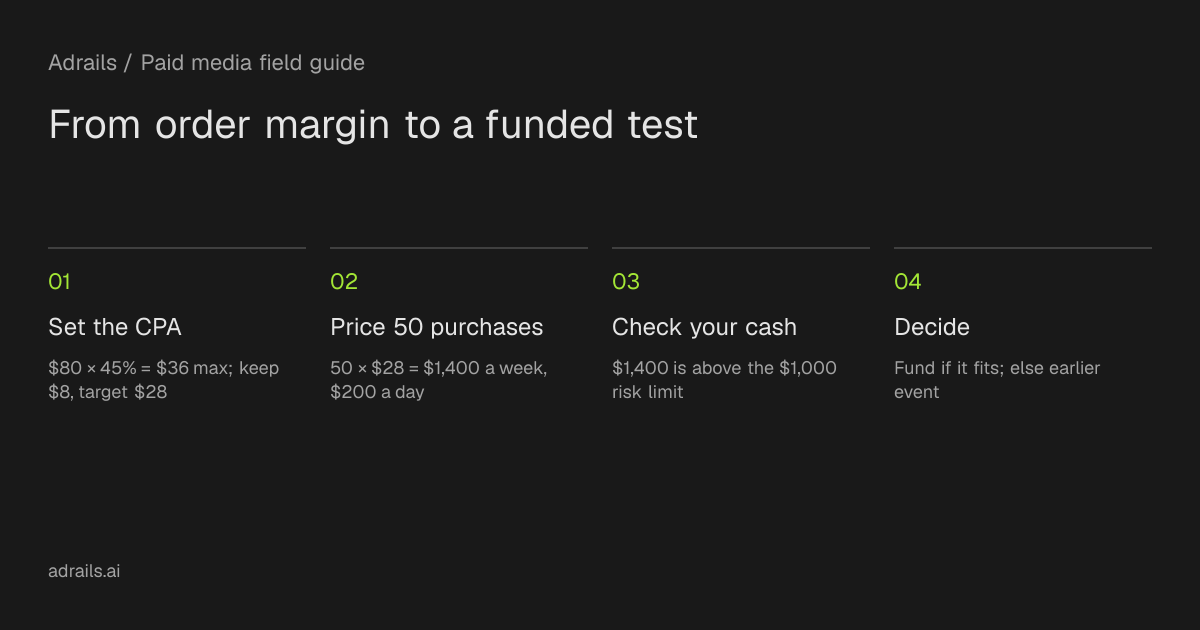
A first Facebook ads test should be sized from the cost of about 50 purchases in a week, not from a round number. This worksheet takes an invented store with an $80 order and a 45% margin from max CPA to target CPA to a weekly and daily budget, compares it with the cash at risk, and picks fund, shrink or an earlier event.
By Adrails · AI-assisted guide · Published
Working reference
Test budget worksheet for an invented $80, 45% margin store
| Step | Calculation | Result |
|---|---|---|
| Max CPA | $80 × 45% | $36 |
| Target CPA | $36 − $8 profit kept | $28 |
| Weekly budget, 50 purchases | 50 × $28 | $1,400 |
| Daily budget | $1,400 ÷ 7 | $200 |
| Stress test at max CPA | 50 × $36; ÷ 7 | $1,800 a week; about $257 a day |
| Cash the owner can risk | Owner's decision (invented) | $1,000 |
| Purchases the cash buys | $1,000 ÷ $28 | About 35.7, under 50 |
| Earlier event, 50 add to cart | 50 × $10; ÷ 7 | $500 a week; about $71.43 a day |
Illustrative figures only. The $8 profit, $1,000 risk limit and $10 add to cart cost are assumptions. Replace them with your own numbers.
01
The short answer: price 50 purchases, then check your cash
A first test budget is the cost of about 50 purchases in one week for one ad set. Weekly budget is target cost per purchase times 50, and the daily budget is that divided by 7. Meta's help page says ad sets usually leave the learning phase after about 50 results in the week after the last significant edit, and that ad sets in learning are less stable and usually have a higher CPA.
For the invented store below, that works out to $1,400 a week, or $200 a day. Whether you should spend it depends on a second number: the cash the owner can lose without damage. If the budget is larger than that, the answer is to shrink the test or move to an earlier event, not to spend anyway.
02
Step 1 and 2: max CPA and target CPA from margin
This is an illustrative store, not customer data. It sells an $80 average order and keeps 45% after product cost, shipping, payment fees and expected returns. The Adrails target CPA guide defines break-even CPA, also called max CPA, as order value times contribution margin: $80 × 45% = $36. Above $36, each first order loses money after ads.
Now choose the profit you want to keep per first order. Keeping $8 gives a target CPA of $36 − $8 = $28. The $8 is a choice made for this example. Use your own figure, and count repeat purchases only if you have measured them in earlier cohorts.
03
Step 3: turn the target into a weekly and daily budget
At a $28 target, 50 purchases cost 50 × $28 = $1,400 for the week. Divided by 7, the daily budget is $200. Use one ad set, so the 50 events are not split across several learning processes.
Then stress test it. Because CPA is usually higher while an ad set learns, run the same arithmetic at the $36 max CPA: 50 × $36 = $1,800 a week, or about $257 a day. That is the most the test could cost before the 50 purchases stop paying for themselves. If you let a Birch-style first test of 1.5 to 2 times target CPA a day set the budget, that would be $42 to $56 a day here, which the cost guide says tells you whether the ad gets clicks, not what a purchase costs.
04
Step 4: compare with the cash you can risk
Suppose the owner can afford to lose $1,000 on this test without missing supplier or payroll payments. This number is invented and is a decision for the owner, not a benchmark. Treat ad spend as cash out first and revenue as uncertain.
The $1,400 plan exceeds $1,000 by $400, and the $1,800 stress case by $800. Spending the full $1,000 would buy about 35.7 purchases at $28 ($1,000 ÷ $28), which is under 50, so the ad set would probably be marked learning limited. That label is a delivery diagnostic, not an error, and delivery continues. But it means the test may not reach stable signal.
05
Step 5: fund, shrink or optimize an earlier event
Use this order of decisions. Fund the plan if the weekly budget is within the cash you can risk, ideally with the max CPA stress case also within it. Shrink the plan only if you accept fewer than 50 results and read the outcome as weak evidence. Optimize an earlier event, such as add to cart, if 50 of those events fit inside your cash limit and still relate to purchases.
Illustratively, if add to cart costs $10 (an invented figure), 50 events cost $500 a week, about $71.43 a day, which fits inside $1,000. For this store the decision is therefore to optimize add to cart and read purchases alongside. The learning limited guide warns that a hundred add to cart events are not fifty purchases, so do not pick a cheaper event just to remove a label. Record the event, the date and the review date before you change anything.
06
What this evidence cannot tell you
The sources do not show that this store will get purchases at $28. Lebesgue's 2026 ecommerce figures put cost per purchase between $20.47 and $39.03 by category, with fashion at $28.08, so $28 is not absurd, but these averages mix countries and account sizes. A store with a US-heavy audience may pay more.
Nor can the sources say how many add to cart events turn into purchases, what your returns will be, or whether Meta will deliver at a cost per result goal. The margin, the $8 profit, the $1,000 risk limit and the $10 add to cart cost are all assumptions. Replace them with your own order data, and check actual spend and events after seven complete days.
Read more
- Facebook ads cost in 2026: CPM, CPC and CPLSource and further reading for this guide.
- Target CPA: how to calculate it for Google Ads and MetaSource and further reading for this guide.
- Learning Limited in Facebook and Meta ads: meaning and fixesSource and further reading for this guide.
Common questions
Why 50 purchases and not a flat daily budget?
Meta's help page says ad sets usually exit the learning phase after about 50 results in the week after the last significant edit. Pricing that volume ties the budget to your cost per purchase rather than to a round number.
What if I cannot afford the weekly budget?
Do not spend it anyway. Either accept fewer than 50 results and treat the read as weak, or optimize an earlier event where 50 events cost less. The earlier event must still relate to purchases, so read purchases next to it.
Should the budget use target CPA or max CPA?
Use target CPA for the plan and max CPA as a stress test. Meta notes that CPA is usually higher during learning, so the max CPA case shows the highest cost you can carry before the first orders lose money.